
Table of Contents
Building a digital marketing plan and strategy for regulated industries isn’t just a matter of picking channels and writing content. When you’re working in healthcare, finance, legal, insurance, or any other space where claims are scrutinized, one wrong statement in a blog post or ad can create real compliance exposure — not just a bad conversion rate.
I want to be upfront about something before we go further: I haven’t personally run a marketing campaign for a regulated-industry client yet. What I have is two years of hands-on experience in digital marketing strategy, SEO, content marketing, and website optimization, plus research into the compliance considerations that make regulated industries different. This article is a strategic framework built on that combination — not a case study. If you’re in a regulated space, treat this as a starting point, and loop in your legal or compliance team before anything goes live.
Why Regulated Industries Need a Different Approach
Planning a digital marketing plan and strategy campaign within a regulated industry isn’t all that different from planning one outside of such industries. The difference is the level of scrutiny with which you have to handle claims, sources, and the media channels through which those claims are made.
One major mistake that has been seen over and over again in non-regulated industries with regards to SEO and content is creating content without first verifying the claims or sources used in it. Businesses are more concerned about getting the content written and optimized for keywords than they are about its accuracy. While in most industries this might just mean a problem with quality, in a regulated industry this could be a compliance issue as making unfounded claims relating to health, finances, or the law could open a business up to liability.
This means that claim verification, credible sourcing, authorship, and disclaimers have to be part of a formal review process for content.
The Full Planning Process, Before You Touch SEO
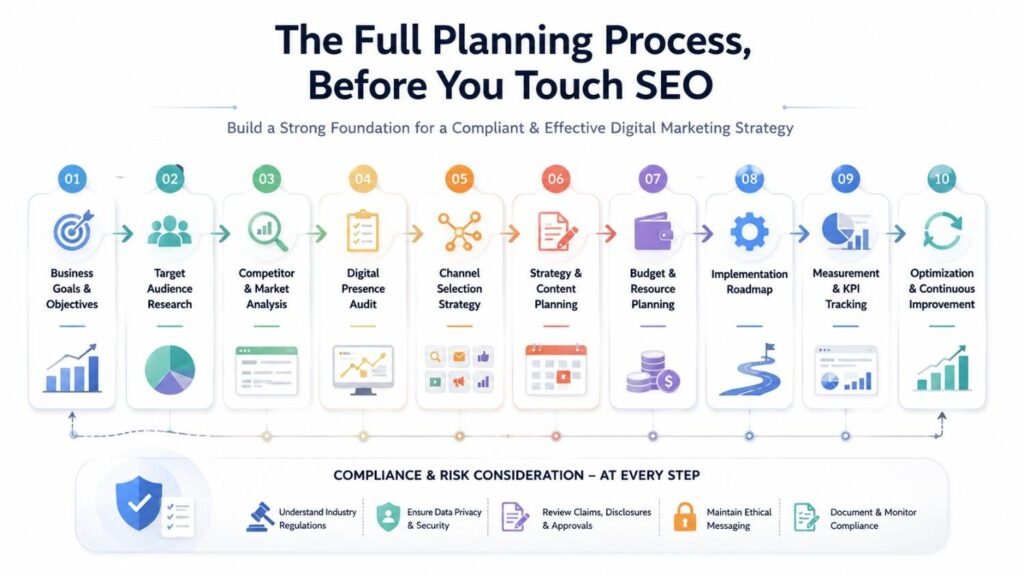
However, the terms “SEO execution” and “digital marketing plan and strategy are often incorrectly considered synonymous. While there is some relation between the two, they are certainly not identical. In order to undertake any SEO activity, prior to that we have to go through a sequence of steps as follows:
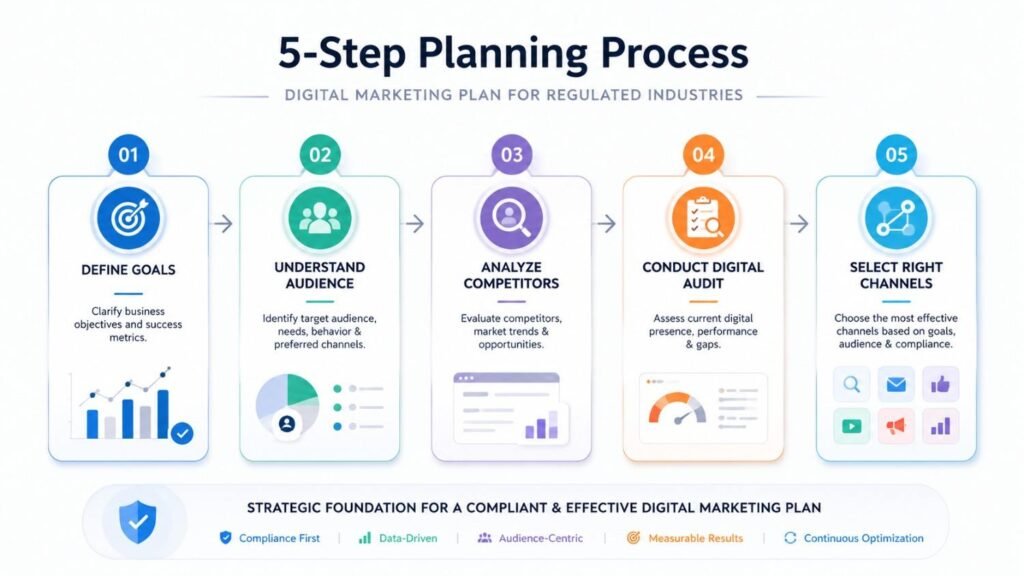
Determine objectives. Do you want to generate leads, sales, improve brand recognition, traffic, or attract more qualified visitors?
Determine target audience. Who exactly is your client? Which challenges does the business face and how is the decision made?
Competition analysis. Channels and approaches used by competitors.
Audit existing presence. It includes website, SEO, content, social media, Google Business Profile, existing campaigns, etc.
Channel selection. Based on goals, audience, competition, resources, and budget, not just because you can use all existing channels.
This way, only after completing such preliminary research, will SEO execution take place in the following order: technical audit, on-page optimization, content quality analysis, and only then off-page activities, such as link building and digital PR. Not paying attention to all of the above and starting off with off-page SEO is one of the most common mistakes companies make.
Where Regulated Industries Change the Plan: Channel Selection In Digital Marketing Plan and Strategy
For the regulated industry client, the entire process described above remains the same; the difference is that the channel selection now is included in the compliance evaluation stage rather than being solely budget- and audience-related.
Here is the modified process:
- Evaluate the existing regulation for the company – the claims and information that it can
communicate legally.
- Evaluate the risks associated with each channel depending on its targeting capabilities, ad policies, handling of data and privacy, use of influencers/testimonials, and possibility to review the content prior to publishing.
- Select the channels that match that risk profile, rather than believing that all the channels are equally safe to use.
Develop a messaging strategy based on the claims that can be made legally.
Implement an approval process for all the content before publication.
Monitor the ongoing performance and compliance of all activities.
Channels That Need Extra Caution
There are certain mediums that have higher risk of non-compliance than others, especially due to the way that they deal with their claims, testimonials, and targeting in digital marketing plan and strategy
- Paid social advertising
- Influencer marketing and testimonials
- Claims and comparisons
- Specific types of targeting
Local SEO Still Works — But Watch the Tactics
Local SEO remains a legitimate, useful channel for digital marketing plan and strategy regulated businesses. The issue isn’t the channel itself — it’s specific tactics that create risk regardless of industry:
- Fake or incentivized reviews
- Misleading business information
- Keyword stuffing in listings or content
- Unsupported claims in business descriptions
Avoiding these isn’t unique to regulated industries, but the consequences of getting caught are more serious when a regulatory body is watching.
A Simple Compliance Checklist for Content
Before publishing anything in a regulated space, run it through a short review:
| Check | Why it matters |
| Is every claim backed by a credible, citable source? | Unsupported claims are the most common compliance trigger |
| Is authorship clear? | Regulated content often requires identifiable, qualified authors |
| Are disclaimers included where relevant? | Protects both the business and the reader |
| Has legal/compliance reviewed it? | Marketing expertise isn’t a substitute for regulatory expertise |
| Does the channel match the risk level of the claim? | High-risk claims shouldn’t go on low-review channels |
FAQs
Is industry experience in marketing necessary to develop a digital marketing plan and strategy for a regulated industry? No, but you need to study the laws very carefully and involve compliance experts in reviewing your proposal. Experience in general digital marketing plus appropriate compliance research can be used as a basis for developing a digital marketing plan and strategy
Can a regulated business use paid social media marketing?
Maybe, but this channel should be examined more critically in regard to its target audience, testimonials, and claims compared to a non-regulated one. You should analyze each channel separately.
What about local SEO in regulated businesses?
This channel is still applicable because it’s more controllable than others; however, you need to stay away from any risky actions like fake reviews and similar.
What’s the first step in building a digital marketing plan for a regulated business?
It starts the same way as any digital marketing plan — defining goals, researching the audience, and auditing the existing online presence — before layering in a compliance review of applicable regulations and claim restrictions. For a closer look at how that planning process fits with SEO execution, see our guide to the SEO execution framework