
Table of Contents
After a few hours of googling on-page SEO vs off-page SEO ,” you will notice that there are plenty of definitions available on the internet; however, those definitions do not help in any way to implement the concepts. Being an SEO professional for past two years and conducting SEO services for my online marketing company as well as my client websites, I must say that there isn’t any problem with understanding the definitions of those SEO concepts; the problem lies in the sequence of their implementation.
I have messed up the sequence myself, and my clients have messed up the sequence as well. Therefore, rather than giving you another general definition, I am going to share some practical insights that I gained while implementing SEO strategies on actual websites.lets deep dive into the topic On-Page SEO vs Off-Page SEO
What Is On-Page SEO?
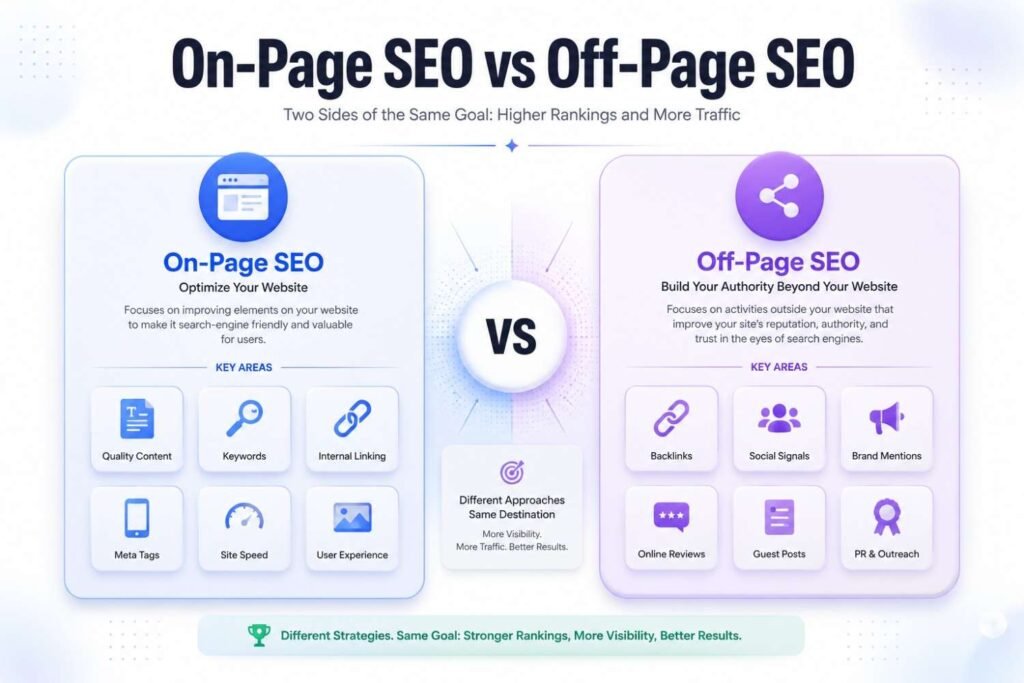
On page SEO is all about things that you can control on your website. These include:
Keyword analysis and usage
- Title tag and description optimization
- Heading optimization (H1, H2, H3)
- Quality and relevancy of content and search intent
- Internal links
- Image alt text
- Technical SEO (site speed, mobile friendlyness, crawlability and site structure)
This is the basics. If you cannot optimize your website on page, then no other efforts will work for you.
What Is Off-Page SEO?
“Off-page SEO” is any kind of effort made outside of your website to show authority and trust indicators to the search engines. Examples include:
- Link Building
- Guest Blogging
- Digital PR
- Local SEO & Citations
- Internet Brand Mentions
Off-Page SEO is telling Google, “These trustworthy sites vouch for this site.” This will be significant only if the site which you are vouching for is worthy of vouching for.
On-Page SEO vs Off-Page SEO: The Real Comparison
Although on-page SEO and off-page SEO target the SEO rankings of a website from different fronts. On-page SEO happens on your website and determines aspects like content, structure and technical SEO,
this is where factors like title tag, header optimization, inter-links and page loading speed come into play. It is quick to manifest its effects and more measurable too. Off-page SEO, however, happens outside your website and is focused on increasing your authority, reputation and credibility through backlinks, guest posts and public relations mentions. Its effects accumulate over time rather than giving instant results. While neglecting either one would mean bad rankings even though you have great backlinking or awesome content respectively. But if you were to choose the former of the two to focus on initially, on-page SEO should win without a doubt every single time. Here’s why.
A Real Example From My Own Website
For instance, not long ago, I used to have a page offering a particular service, which ranked well for absolutely nothing despite being properly optimized for a keyword. After taking a closer look at it, however, I found out that the reason for its poor performance was on-page rather than off-page: it failed to incorporate the keyword effectively into its title and headings, it featured an ordinary description, its content didn’t match the actual searches conducted with this keyword, there were no internal links whatsoever, and it lacked alt attributes for pictures.
Upon making some changes in titles and headings, restructuring the content in accordance with user queries, inserting some internal links from relevant pages, giving alt attributes to images and optimizing their size in order to increase page loading speed, in about a month I started noticing improvements in indexing of this page, growing impressions in Search Console, improving rankings for several target keywords, and, most importantly, an increasing amount of organic traffic – without getting even a single backlink. That is why I started believing that on-page optimization is not just “step number one” on your checklist.
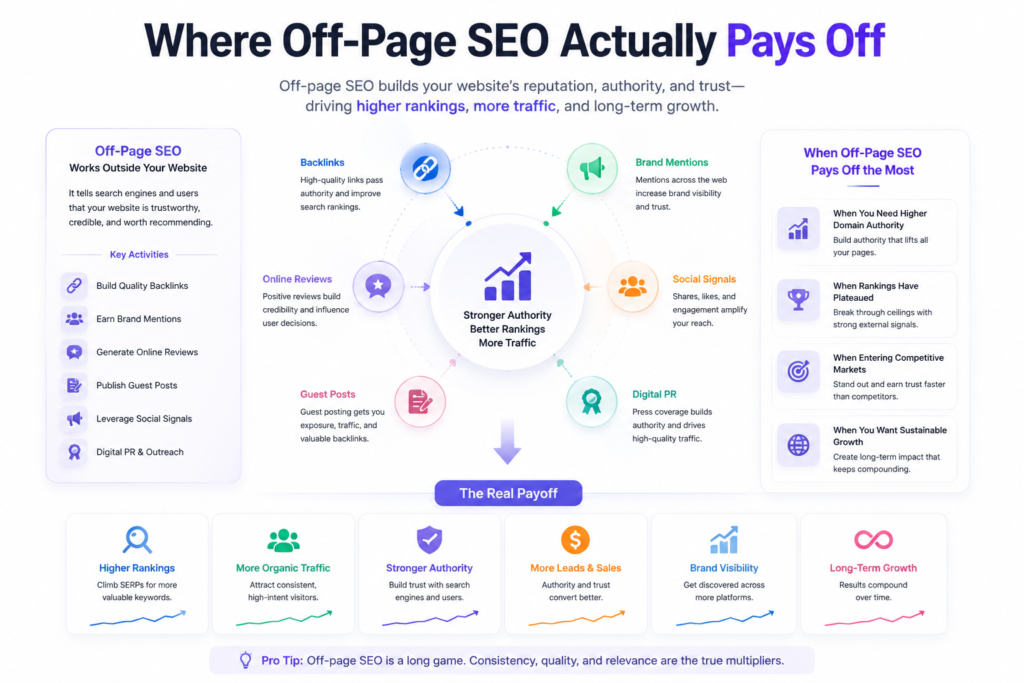
Where Off-Page SEO Actually Pays Off
That is not to say that off-page SEO is unimportant – it is just not the place to begin. Once a website has a good base of on-page SEO, off-page SEO is the factor that will take things even further and establish authority.
One strategy that has worked for me every time is the creation of backlinks from high-quality guest posts on websites that are relevant to your field.
One tactic that I have tried which definitely was not worth my time was putting links into bad directories. It took hours of my time with no change in my ranking or traffic numbers.
The Biggest Mistake I See: Chasing Backlinks First
If there’s one myth I’d want every beginner (and honestly, some clients) to unlearn, it’s this: more backlinks does not automatically mean better rankings.
I’ve seen sites pour time and budget into link building while the actual website underneath is barely optimized — thin content, no clear keyword targeting, poor user experience. Those backlinks end up carrying a page that isn’t built to convert that authority into rankings. It’s like promoting a store with a leaky roof. The foot traffic doesn’t fix the store.
A strong on-page foundation should always come first. Off-page SEO amplifies what’s already there — it doesn’t fix what’s broken.
My Process: How I Decide Where to Focus First
A few things that back up putting it in that order:
Technical first — if Google can’t crawl or render the page properly, nothing downstream matters. Site speed and mobile usability are also direct ranking factors now, not just UX nice-to-haves.
On-page second — you’re making sure the page is legible to search engines and structured around the right intent before you try to prove relevance externally.
Content-quality check third — this is the step most people skip or merge into on-page, but treating it as its own checkpoint is smart. A page can be technically perfect and well-optimized and still fail to actually answer the query.
Off-page last — you’re only building authority once there’s something worth pointing authority at.
The “people skip to step 4” mistake is common because link building and guest posting feel like the visible, active-looking work — it’s easier to point to “we got 10 backlinks this month” than “we fixed 40 crawl errors.” Off-page also gets oversold by agencies because it’s a repeatable service to bill for.
Want me to turn this into a blog post or client-facing one-pager? Given the audience — is this more for other freelancers/marketers who’d nerd out on the “why,” or for prospective clients who need to understand why you won’t just do backlinks on demand?
On-Page SEO vs Off-Page SEO: Which Matters More?
The truth of the matter is that this is not a competition; rather, it is a process. On-page SEO establishes your rankings’ platform. Off-page SEO helps establish the authority that will make your platform stronger. You cannot do without either and expect your rankings to reach new heights.
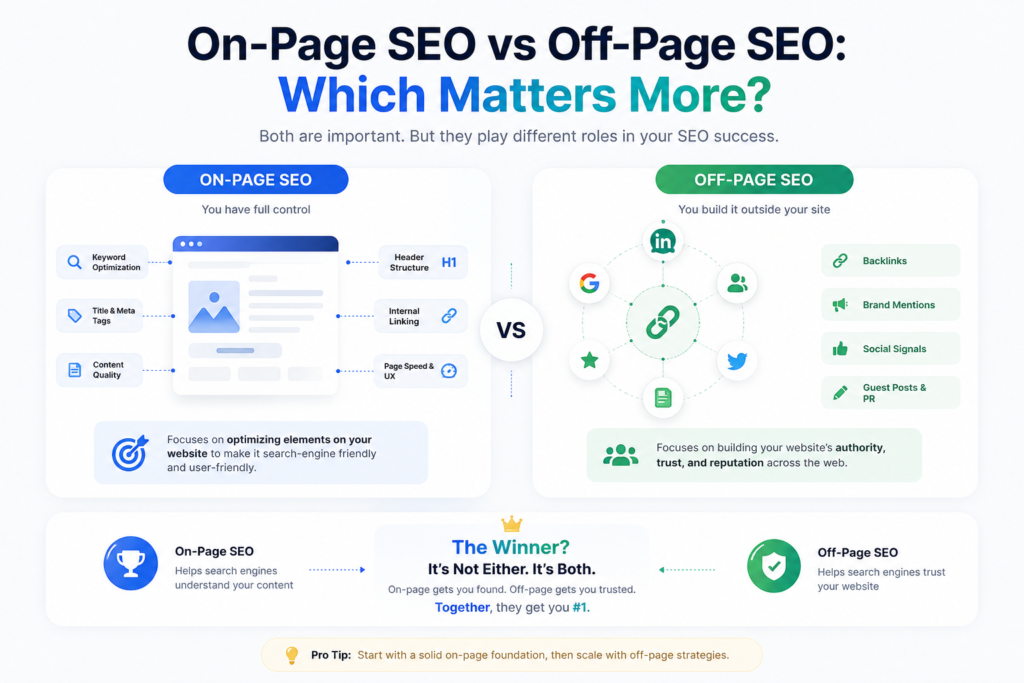
Where there are time and financial limitations, on-page SEO should be the priority before moving to off-page SEO
FAQs
Do I need On-Page SEO vs Off-Page SEO, or is on-page SEO enough?
When comparing On-Page SEO vs Off-Page SEO, both are important, but not at the same stage. Strong on-page SEO helps your website get indexed, improves relevance, and increases visibility for your target keywords. As your site grows, off-page SEO builds authority through backlinks, brand mentions, and digital PR, helping you rank for more competitive search terms.
When will I see results from on-page SEO?
Indexing and impressions should take place rather quickly – within a few weeks. But the rankings are taking much more time – depends on how competitive the market is.
Is off-page SEO the same as backlink SEO in On-Page SEO vs Off-Page SEO?
No. In the On-Page SEO vs Off-Page SEO comparison, backlinks are only one part of off-page SEO. Off-page SEO also includes digital PR, brand mentions, local citations, online reviews, influencer outreach, and reputation management, all of which help strengthen your website’s authority and trustworthiness.
How can I improve my website’s SEO?
Improving SEO involves optimizing content, fixing technical issues, and building quality backlinks.How to Improve Your website Ranking
Final Takeaways
Understanding On-Page SEO vs Off-Page SEO is essential for building a successful long-term SEO strategy. While both work together to improve your search rankings, the order in which you implement them matters.
- On-page SEO comes first; don’t spend on off-page until this part is sorted.
- Off-page SEO techniques (such as guest blogging) are most effective when used on a site that has been optimized.
- All backlinks are not created equally; quality backlinks beat directory submissions any day.
- Audit > fix on-page > validate search intent > now build off-page authority.
- In the On-Page SEO vs Off-Page SEO debate, the best approach isn’t choosing one over the other—it’s applying both in the right sequence. That’s what separates successful SEO campaigns from those that struggle, regardless of how much is spent on link building.
It’s all about getting the order right – this is the difference between successful SEO programs and those that flounder regardless of budget spent on link building